


In my previous post, I touched on diamonds at several points. I talked about their varied cuts, their outstanding hardness, and the reasons for their unique position in engagement and wedding rings. As a result of all this, many people come to the point where they decide that they really want a diamond, but they have no idea about the prices, the qualities, the differences, and they don't dare spend a significant amount of money without proper insight. I'm trying to provide a little help with this.
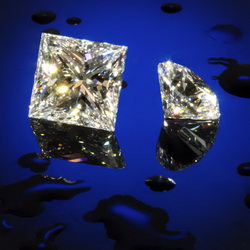
It is a fact that the world of gemstones is not only mysterious because of their nuanced diversity, but even for an expert it is not clear at first glance what they are holding in their hands.
(in tweezers). In order to say something accurate and correct about a gemstone, it must be removed from the jewelry (which in most cases results in its destruction), gem testing lab equipment is required, which is not common equipment even in a serious goldsmith's workshop, and you must have expertise and up-to-date knowledge. And even then, the result is not certain, because every day new and new modification procedures are developed to "repair" gemstones, and optical tuning makes the stones more saleable, but reduces their value. As a result, I myself do not dare to buy gemstones from any source.
Fortunately, the system is very strict when it comes to diamonds, and stones are classified on a nuanced spectrum that, in principle, means the same thing everywhere in the world. So even the average person can differentiate between diamonds, and only between them, with the help of certificates.
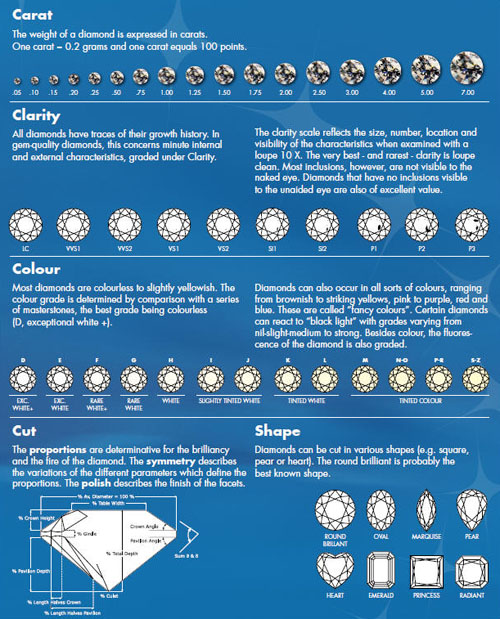
The value and quality of diamonds have long been determined by the "4Cs". The 4Cs are: -Cut, -Clarity, -Colour, and -Carat. These are the most important pieces of information that determine the quality of a diamond, although there is a lot of other information that may be equally important, but I will only go into this if a question arises.
You can play better with 2 of the 4Cs, as the customer will soon make a decision about what shape of stone they want (Cut) /although this C indicates something else, but this is additional information/ and what size will fit in their wallet or match the given piece of jewelry (Carat).
Color and clarity remain. Although the spectrum is very subtle, and the untrained eye does not notice the differences between neighboring categories, these can be juggled for a long time, so that prices change. It is important to know that these are not only pricing information, but from the point of view of the jewelry, its beauty, durability, repairability and similar aspects may require serious consideration.
The color is less problematic. The scale is also easy to understand. The "D" color is the whitest, then "E,F,G,H..." we go towards the yellower colors. Without the right diamond lamp or natural light, these listed categories are very difficult to distinguish. A D color is already extreme, and accordingly especially expensive, it is not customary to choose it because of its beauty, but because we want the best. Most good quality jewelry has a FH color, which is still a nice white, but they are in a reasonable price category. IJ is a compromise, but most people do not yet see the yellowish tint in them. By KM we start to feel that the stone is turning yellow, but it is not dangerous. The price just drops. The color can then reach categories that are clearly yellowish, but not yet full-blooded yellow, because they are already considered "fancy colors", i.e. not a shade of colorless, but they are sought after for their color. I won't talk about special diamond colors now, because that's a big topic.
Let's look at the clarity. This is an important factor. Here we define it by marking the most inclusions with the numbering P3, P2, P1, where 3 is the worst. This is a dull stone full of inclusions that are clearly visible to the naked eye. Then come the SIs (Small Inclusion or Slightly Included). SI3,2,1. The 3 is still noticeably included, the 2 is less so, and in the 1 it is very difficult to notice the inclusion with the naked eye. From here come the VSIs (Very Small Inclusion) VSI2, VSI1. Here we are talking about very beautiful stones, in which the inclusion can only be discovered with a magnifying glass, and even that is difficult. VVS stones are considered particularly clean, and the cleanest are marked "IF" (Internally Flawless). SI stones are used for average jewelry, we use VSI in most cases, which I feel is above average, and VVSIs when we make something special. IF is already at an extreme price, but many people are looking for perfection, and it is not uncommon for someone to want one.
These are just data. However, the presence of inclusions can not only reduce the brilliance of the stone (from the SI category down), but if the jewelry is exposed to heat (repair, transformation), it can also crack along this line, which then cannot be re-attached by man, i.e. the stone will be destroyed. Such accidents can be caused not only by heat, but also by physical effects (impact, pressure), i.e. general use. So be careful with inclusions!!!
In any case, the categories are also reflected in the price. Especially above 0.5-1ct. (1ct=0.2g). Be careful, the fineness of gold is measured with the carat marked with the letter "K", where 100% is divided into 24 parts, 24 carats. In the case of precious stones, the carat is marked "Ct" and indicates mass. Even professionals are often confused by similar names, and in more than one case I see the designation Kt, C, and even sometimes the gram Gr, which differs from the SI system. These are incorrect.
There is an awful lot more to say about diamonds. I will try to summarize the main points. I look forward to your questions!
