


White jewelry is a concept. Even in the time of our grandmothers, elegant and valuable white jewelry was considered a separate class. Although deprived of color, it achieved its effect with its shape and shine, and was still able to stand out from its peers.
So, in white jewelry, both the metal and the stone are white, or if you prefer - colorless. There are many types of metal that can be white (we'll come back to this later), but unfortunately there aren't many types of stone that I can really recommend with a good heart. Especially not for a ring or wedding ring, because of the wear and tear.
Diamond is the king. Other colorless gemstones are dull and soft in comparison, making them vulnerable and losing their beauty. The relatively hard white sapphire shines beautifully at first, but it quickly becomes dull due to impurities and its brilliance is reduced to zero. White topaz is no different, but it is even softer and more fragile. Real zircon has a very good shine, but its softness does not make it an ideal wedding ring gemstone. There are many other colorless gemstones, but they are all serious compromises.
Among the artificial products, zirconia has been dominating the world of mass jewelry for decades to imitate diamonds. Its beautiful shine is outstanding compared to the colorless versions of most colored gemstones, but it cannot compete with diamonds. It has no value because its birthplace is the laboratory, so it has no rarity, no real value. Unfortunately, its hardness is not outstanding, and because of this, rings decorated with it will soon wear out with use, lose their vivid shine and shape. The most modern diamond-imitating artificial product is Moissanite, which is surprisingly hard, its brilliance is barely inferior to diamond, its dispersion even surpasses it, but despite the fact that it is an artificial product, its price is very high, comparable to diamond. Thus, it is not very widespread in the world.
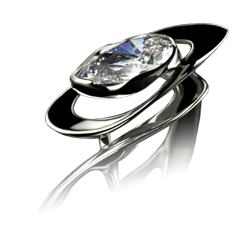
So diamonds are not just for advertising It has a prominent, but also dominant role based on its properties. It was already known in the Middle Ages, and was worked along its cleavage planes, but its true shining beauty could not be extracted from it for a long time. Today's modern grinding processes give free rein to its processing, especially since laser technology has helped.
The (round) brilliant cut, which can be considered ideal in many ways, is one of the most common because it is rich in colors and light, and can be easily incorporated into all kinds of jewelry designs, including wedding jewelry. I think the princess (square), marquise (plum seed shape), pendeloque (drop shape), tilliant (curved triangle) shapes are the most beautiful, because their light and shape make them very exciting. My personal dislike for ovals developed only because of their boring shape, but their brilliance is optimal. There are many other cut shapes, including common ones such as: baguette, emerald cut, heart, cushion, or the less commonly seen: radiant, asscher, or fantasy cut versions such as: half-moon, star, dragon, etc., so jewelry design is no longer limited by the difficulty of working diamonds.
Unfortunately, the brilliance of a diamond is so shocking that most of the world forgets that jewelry is originally a personal work of art and has been mass-produced for profit. At the same time, diamonds successfully sell these often boring precious metal objects. Nowadays, the concept of luxury jewelry seems to merge with jewelry sprinkled with diamonds, which to me is quite empty, but the role of diamonds is undeniable.
My personal belief is that anyone who would choose jewelry for their wedding or engagement is looking for something personal, unique, special, and beautiful for a lifetime, that is, something that will last. Diamonds are a good partner in this, but apart from their lasting brilliance, they don't have many other virtues. The jewelry itself must carry the personality and uniqueness, and that is why we see each order as a challenge to make it truly individual through individual design and personal connection options.
