


In the previous section, we touched on the topic of gemstones, which play a central role in engagement rings. However, the world of gemstones is so diverse and has such depths that it is impossible to cover them in one blog. Still, I think it is a very exciting topic, and I think it is worth discussing at least the important things from the point of view of wedding rings.
I have already talked about colored diamonds, but I have not explained which colored gemstones are suitable and popular for rings.
We approach gemstones (and jewelry) primarily from a technical perspective, because we want to ensure that the less obvious features in the construction of rings (or other jewelry) are included in the selection. So we talk a lot about their wear resistance, allergenic properties, comfort, durability, value retention, and measurable optical properties. It is also particularly important for us that the result is beautiful, even delightfully beautiful, but we do not force our taste or style on the customer. However, we try to direct the design towards the best quality result possible, so that we can create not only durable jewelry, but also lasting value, which generations will then be happy to wear.
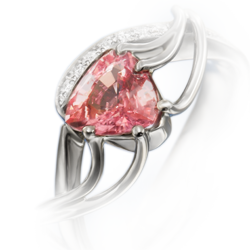
Among the colored gemstones, my favorites are the corundum varieties (e.g. sapphire, ruby), because they have outstanding hardness among colored gemstones, have a high refractive index (they can also shine), cannot be split, and are found in many color shades. Generally, the blue sapphire is widely known, and the red one, which is called ruby, but is not really sought after in Hungary. In addition, there are green, purple, orange, pink, yellow, colorless (which is also used instead of diamonds, although its light is so weak compared to it, and when polluted, it decreases to such an extent that I do not recommend it for a wedding ring), and it exists in almost every color, but one of my favorite colors is the padparadsha color, which means lotus flower in Sinhala and denotes a shade between pink and orange, which is the rarest among sapphires.
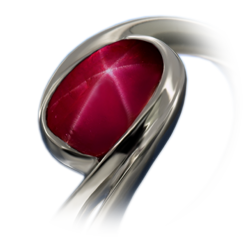
I also like gemstone rarities and special features, such as star sapphires (star rubies). In these gemstone varieties, three "light strands" intersect, and a wandering star can be seen inside the gemstone. This very rare light effect is the result of light refraction on the microscopic rutile needles of the stone, so star-effect stones are mostly opaque, although there is a special quality that is both transparent and star-effect. (I once looked for a pair of such special quality stones for a set, and it took me 2.5 years to find them in the world.) So these are very rare, but very special.
We like sapphires because of their variety and good qualities. They are not cheap among colored stones, but they cost much less than diamonds. Since engagement rings tend to start out as diamond jewelry, a colored center stone can be much larger for the same price, within the same budget, or we can save a lot on it. Of course, the color is not a wild card like a diamond, and so it does not fit into every color scheme during a lifetime of wearing, but someone especially likes certain colors, and so the colorful nature can even be an advantage.
Sapphire is most often sought after in blue, and the blue (cold) shade harmonizes very well with the white metal (although it does not beat the yellow either). The elegant overall effect thus created has been very popular for centuries, meaning it is not the equivalent of a momentary fashion, but carries a timeless, tried-and-tested aesthetic.
Sapphires are therefore not only technically recommended gemstones as the central shape of wedding rings, but they are also outstanding from an aesthetic point of view, and are consistently among the first on the popularity scale.
